
GuidesSearch
Search
Describe the music in plain words: a mood, a scene, a pace, an instrument. It matches on meaning, so a feeling works as well as a genre. Name a track, an album, an album code, an ISRC or a composer and you get exactly that.
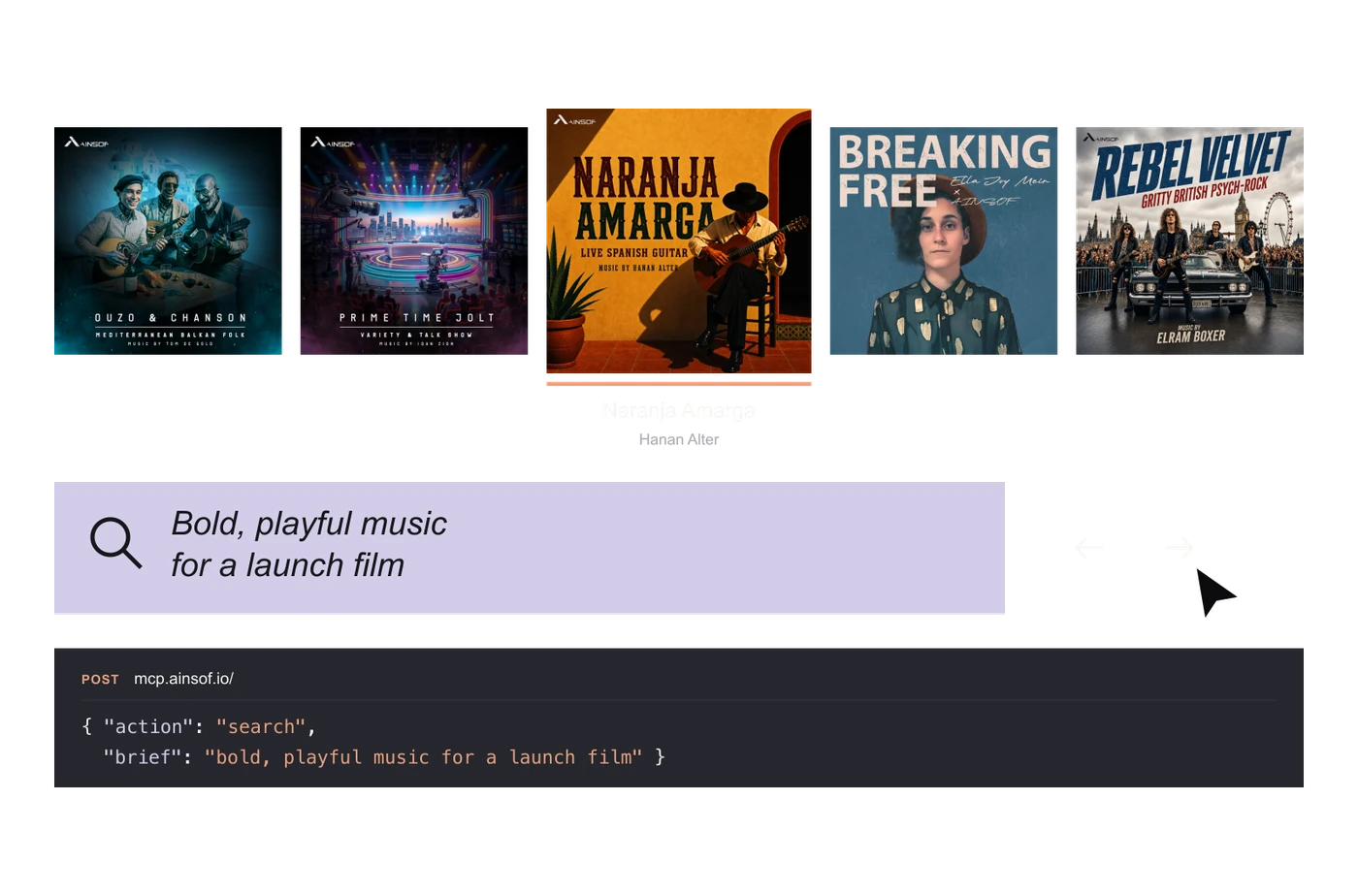
MCP toolsearch_musicRESTaction: "search"
Try it
curl https://mcp.ainsof.io/ \
  -H "Content-Type: application/json" \
  -H "Authorization: Bearer $AINSOF_API_KEY" \
  -d '{"action": "search", "brief": "tense, minimal pulse for an interview, no vocals", "top_k": 5}'
What you send
briefrequiredstring
What the music should be, or the exact name of a cue, album, album code, track id, ISRC or composer. Required unless
link is sent (see Reference search).top_kinteger
Number of results.
Good to know
searchis also what runs whenactionis omitted.- Names are looked up, not searched. When the whole brief is a cue title, an album name (with or without its subtitle in brackets), an album code such as
AIN-CAT 031, a track id, an ISRC (any separators) or a composer's full name, the answer is that cue, that album or that writer's cues, andfound_by_namesays so. A title inside a short brief is moved to the top of an ordinary search instead. - Negatives are enforced.
no vocals,no singing,no voice,no lyrics,without vocals,instrumental onlyandnon-vocal, andnot/no/nothing/without/avoidfollowed by a style word (for exampleno electronic), remove matching cues instead of only influencing the ranking. What was enforced is listed inenforced. - Non-English briefs. A brief written mostly in a non-Latin script (more than 30% of its letters, e.g. Hebrew, Arabic, Cyrillic, Chinese, Japanese, Korean) is translated into an English search phrase before searching;
translated_from.we_searched_forshows the phrase used. Other languages are searched as written. - Composers inside a brief. When a brief also names a composer, that composer's cues among the matches are listed first and
composer_notesays how many of the results are theirs.
Every field it returns, and its errors, in the API Reference